
Welcome NIC Member Fraternities Let's Protect the Potential of every fraternity member.
Identify risk for ADHD, depression, anxiety, and substance use before it becomes an academic, financial, or retention crisis for college men and their local chapters.
Explore our pilot study program.
Talk with our team about a chapter or council pilot program.
Experience the free screening pathway
See exactly what a member walks through, start to finish.
Download the leadership brief
A one-page overview built for chapter and council leadership.
The invisible struggle
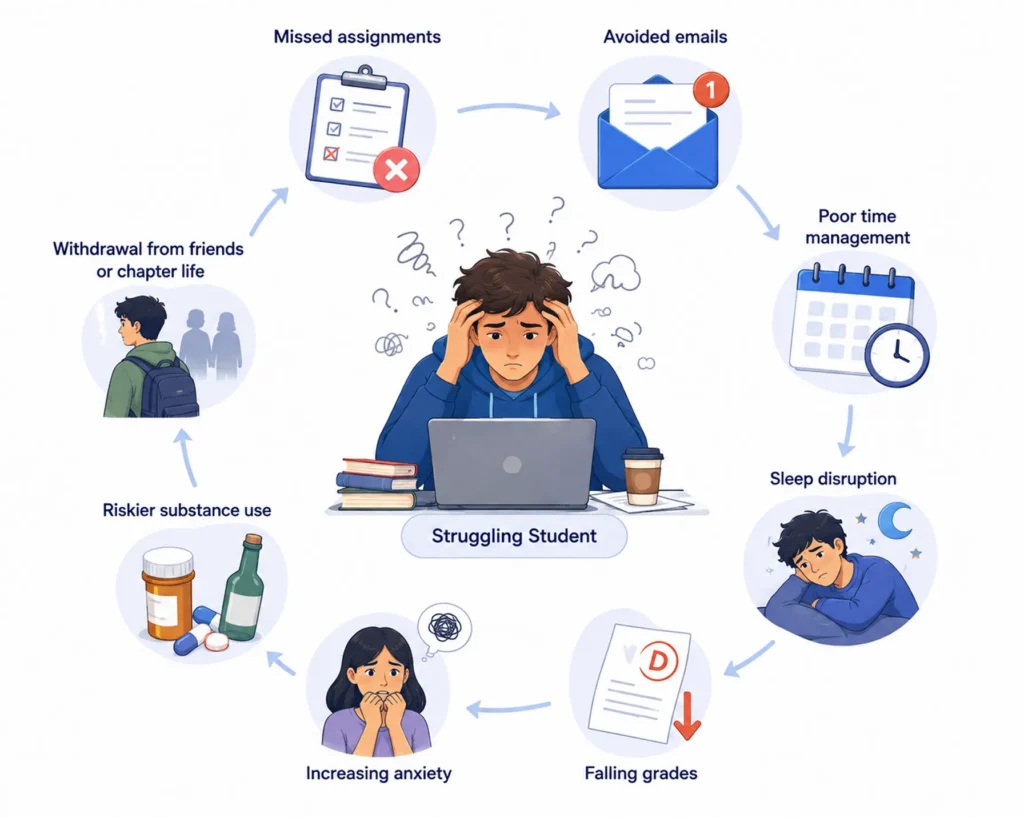
A struggling member does not always look like a struggling member
A talented, motivated student can begin falling behind without understanding why. The warning signs may look ordinary.
A Dad's Epic Fail!
My daughter was a valedictorian in high school. After her first semester of college, she said, “Dad, my roommates think I have ADHD.” I smiled and literally patted her on the top of her head and said, “Sweetie, I’m an ADHD expert, you don’t have ADHD.” Famous last words. After testing we discovered that she indeed has quite severe ADHD, but she masked it with high intelligence, incredible work ethic, and a lot of sleep deprivation. But the story doesn’t end there, despite having resources and some treatment, she struggled more and more. She was embarrassed to ask for help and once she missed a couple assignments, she couldn’t bear to go back to class and face her teacher. So a week before her finals we learned that the only way to salvage her GPA was to withdraw from school. No credits and a semester of tuition literally down the drain.
As a father and ADHD expert, I learned first hand how difficult it can be for even informed families to recognize what is happening soon enough.
Dr. Aaron Dodini
Father and ADHD Expert, AXON Digital Health
To get a clear picture, we think proactive, private, free screening for ADHD, depression, anxiety, & substance use issues can help students, families, & fraternities identify risk factors before the trouble starts & it’s too late.
The stakes
Early awareness protects more than grades
It protects a young man’s trajectory for the student, his family, and his chapter.
For the student
- Academic progress
- Confidence and wellbeing
- Relationships
- Continued enrollment
- Access to appropriate support
For the family
- Insurance for a substantial investment in tuition, housing, and the college experience
- Fear and uncertainty replaced with clarity and confidence
- Easy, private access to world class care and advocacy.
For the fraternity
- Member retention
- Academic standing
- Chapter stability
- Parent confidence
- Leadership development
- A stronger culture of help-seeking
The pathway
Screen. Understand. Connect. Support.
One route, four steps, no dead ends. Your organization is responsible for exactly one of them: making step 1 easy to find.
Screen
Free initial screening for possible ADHD, depression, anxiety, and substance-use concerns.
Understand
Results help the participant understand whether further evaluation or support may be appropriate.
Connect
When indicated, we provide differential diagnostic assessment and a personalized treatment plan.
Support
We provide ongoing ADHD care, medication management when clinically appropriate, and help navigating accommodation requests.
Screening identifies potential concerns; it does not provide a diagnosis. Diagnosis and treatment decisions require an individualized clinical evaluation.
Privacy and clinical independence
The safeguards are the product
This only works if a 20-year-old believes it is safe to be honest. Every one of these is written into the pilot agreement, not just promised on a website.
Participation is voluntary
No member is enrolled, assigned or required by anyone.
Results are never shared
with the fraternity, chapter, university or a parent without the participant's written authorization.
No bearing on standing
Results cannot affect membership, housing, leadership eligibility, discipline or recruitment.
Clinical independence
Decisions stay between the patient and his clinician. We take no direction from headquarters on anyone's care.
Aggregate reporting only
You receive counts and rates. Small cells are suppressed so no individual is re-identifiable.
Crisis pathways built in
988 resources appear wherever depression or self-harm items are used.
The Protect the Potential story
Silent, captioned loop for booth display and this page. Replace the placeholder below with the final export once produced.

Founding Fraternity Academic Success Pilot
Help us demonstrate what proactive member support can accomplish across 15–30 chapters.
6-10
National partners
6-10
Chapters per organization
36-100
Total chapters
1 academic year
Participation at beginning of fall & winter terms
Get Started
Request a pilot conversation
Tell us about your organization and we’ll follow up with next steps pilot details, the member screening pathway, or the leadership brief, based on what you select below.
Frequently Asked Questions
We have the answers for you!
No. Screening and evaluation results are not shared with the fraternity, chapter, university or a parent without that member’s written authorization. You receive aggregated, de-identified engagement figures only — counts and rates, with small cells suppressed so that no individual can be re-identified.
No. Screening identifies potential concerns; it does not provide a diagnosis. Diagnosis and treatment decisions require an individualized clinical evaluation by a qualified clinician. There is no single test that diagnoses ADHD a defensible evaluation combines clinical history, a structured interview, validated rating scales and, where appropriate, objective measurement.
Two things: composition and speed. The evaluation combines a structured clinical interview, validated rating scales such as the ASRS, PHQ-9 and GAD-7, and an FDA-cleared computer-based measure of attention, impulsivity and activity — all interpreted together by a licensed clinician. Most participants complete the process within days rather than the months a campus counseling referral often requires. Reports are written to meet ADA and Section 504 standards and the requirements of campus disability offices.
The screening is free to members, and there is no fee to the national organization to run the pilot. Members who choose to proceed to a comprehensive evaluation pay for that service directly; AXON is out-of-network and provides a superbill for possible reimbursement through out-of-network mental-health benefits.
No, and the pilot agreement says so explicitly. Results have no bearing on membership, housing, leadership eligibility, discipline or recruitment. Building that guarantee in writing is what makes honest answers possible in the first place.
As designed, the pilot is a program evaluation, not research. We measure whether the program reached people and whether they engaged. Any publishable research would require its own protocol, consent process, privacy review and, where applicable, institutional review board oversight — and we would come back to you before pursuing it.
Crisis-response language and 988 resources appear wherever depression or self-harm items are used, and chapter-leader materials lead with what to do in an emergency. Screening is not a crisis service and is never presented as one.