
Raising ADHD awareness starts with sharing accurate information where people already spend time: online, at work, in school, and in college. A social media post, a short talk, or an inclusive activity can help challenge misconceptions and connect people with reliable resources.
October is observed as ADHD Awareness Month in the United States, but awareness matters throughout the year. Here are 29 practical ideas to raise awareness and provide valid information you can use in October and beyond. For background, read our guide to ADHD in adults.
ADHD Awareness Ideas for Social Media and Online Communities
- Share one fact a day. Post an evidence-based fact about ADHD symptoms or misconceptions. Use our guide to ADHD myths and facts to help challenge common misunderstandings.
- Update your profile banner. Add an awareness message that encourages understanding and inclusion.
- Create an educational infographic. Turn reliable facts into a simple graphic about ADHD symptoms, daily challenges, or ADHD and sleep problems. Make it easy for people to save and share.
- Share personal stories respectfully. Highlight publicly shared stories from people with ADHD, crediting the source and getting permission before sharing private content. Sharing your own experience is optional.
- Host a Q&A. Invite a qualified professional to answer general questions without diagnosing individuals online.
- Use accessible visuals. Choose images that avoid stereotypes and add descriptive alt text.
- Join an online event. Attend an educational webinar or awareness campaign and share useful resources with your network.
- Share trusted information. Direct readers to the CDC ADHD Partner Toolkit for educational materials and awareness resources.
ADHD Awareness Activities at Work
- Hold a lunch-and-learn. Organize a short session about ADHD and workplace support, using our guide to the impact of ADHD at work as a starting point.
- Share weekly facts. Post a short educational resource in Slack, Teams, or your staff newsletter.
- Educate managers. Explain how clear expectations, written instructions, and specific feedback can support employees.
- Review workplace flexibility. Consider quieter workspaces, written meeting summaries, and flexible schedules where feasible.
- Explain accommodation processes. Tell employees whom to contact and where to find workplace policies and disability-rights guidance.
- Create an optional peer group. Offer a voluntary space for employees to exchange strategies while respecting privacy.
ADHD Awareness Activities in Schools
- Include a daily announcement. Share an age-appropriate ADHD fact without singling out individual students.
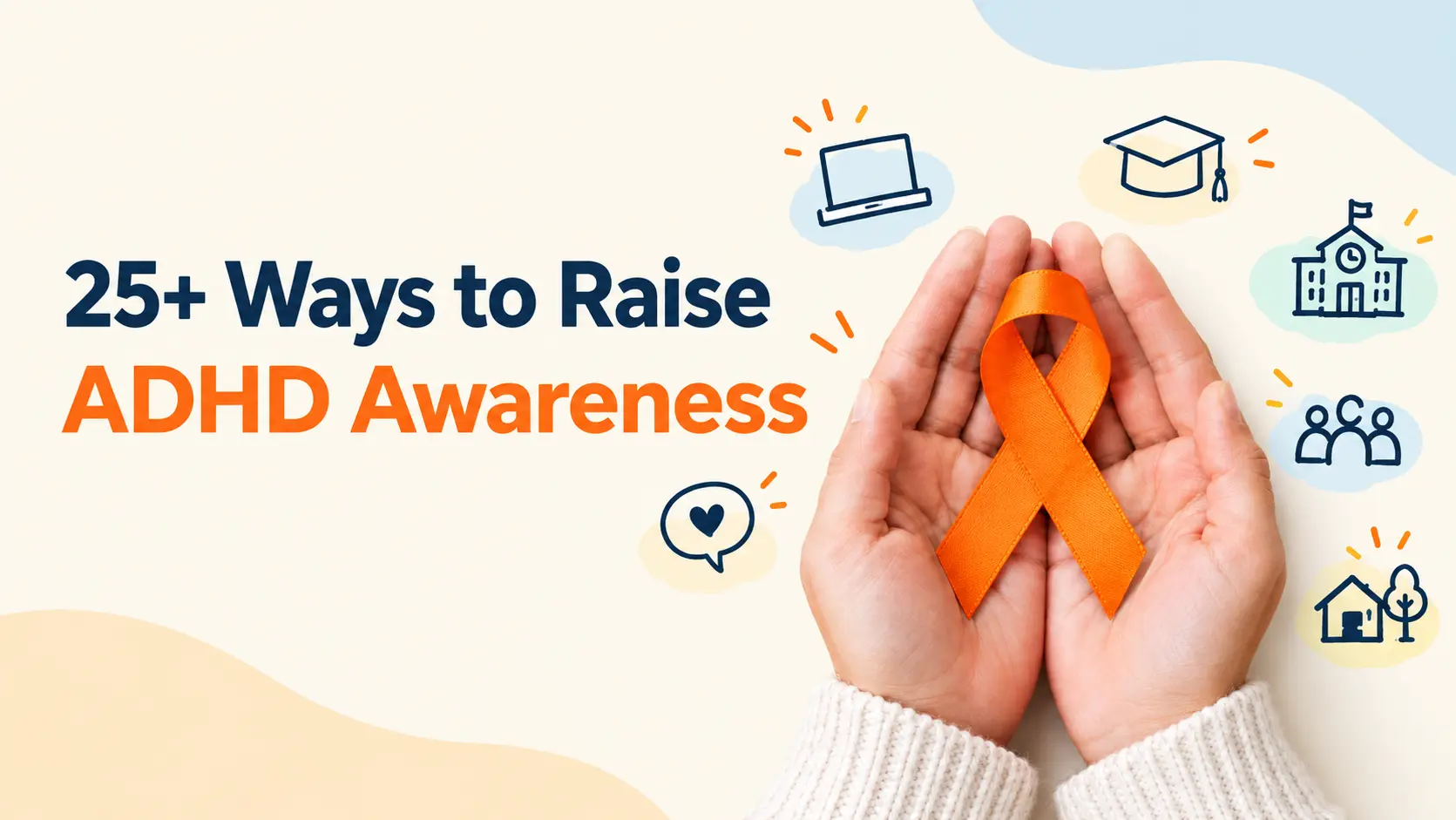
- Organize an awareness day. Invite students and staff to participate in an educational activity. If your campaign uses orange, explain what the color represents.
- Run a poster competition. Ask students to illustrate ADHD myths, facts, and ways to support classmates.
- Offer teacher training. Discuss clear instructions, manageable assignments, and appropriate movement breaks.
- Build a library display. Feature books and reliable resources that represent different experiences of ADHD.
- Discuss overlooked presentations. Explain that ADHD can look different across individuals. Our guide to ADHD in women explores why some people may be overlooked.
ADHD Awareness Activities in College
- Partner with disability services. Share information about campus support and how students can ask about accommodations.
- Run an ADHD self-awareness workshop. Discuss attention, organization, time management, and executive functioning without encouraging self-diagnosis.
- Give professors a resource sheet. Recommend clear syllabi, structured assignments, and accessible course materials.
- Host a body-doubling study session. Let students work quietly alongside one another; some find this helpful when starting tasks.
- Create a campus resource guide. Gather links to disability services, counseling, academic support, and reliable ADHD information in one accessible document.
- Collaborate with student clubs, sororities, or fraternities. Arrange a discussion, resource fair, or educational panel. Students with questions about possible missed ADHD can explore our guide to undiagnosed ADHD in adults.
ADHD Awareness Activities in Your Community
- Wear an awareness shirt or ribbon. If you choose an awareness symbol, pair it with a message explaining the cause.
- Check in with friends and family. Ask how you can be supportive. Share information about common signs of ADHD in adults when someone wants to learn more.
- Partner with local organizations. Work with libraries or community groups on educational events about ADHD and related topics, while explaining the differences between conditions accurately.
Choose One Idea and Get Started
You don't need to organize a major event to make a difference. Share a fact if you have a few minutes, prepare a short talk if you have more time, or collaborate with an organization on a larger activity. Focus on reliable information, respectful language, and listening to people with ADHD.
If you're concerned about your own attention or organization, a free ADHD screening may help you consider whether further evaluation is worth exploring. Screening cannot diagnose ADHD. Learn about a comprehensive ADHD assessment and read our patient journeys. Speak with a qualified healthcare professional about personal concerns.
Frequently Asked Questions
Share accurate information, challenge misconceptions, organize educational activities, and direct people to reliable resources.
ADHD Awareness Month is observed in October in the United States. These activities can also be used throughout the year.
Orange is used by some ADHD awareness campaigns. Colors and symbols can vary, so check your campaign's guidance and explain what your chosen symbol represents.
Partner with disability services, student clubs, and professors. An information table, study session, or workshop can introduce students to available resources and accommodation processes. AXON ADHD would love to partner with you! Email us to collaborate: info@axonadhd.com
No. A screening may suggest that further evaluation could be useful, but it cannot establish a diagnosis. A qualified healthcare professional can assess symptoms and other possible explanations. AXON ADHD provides a fully online OFFICIAL ADHD DIAGNOSIS EVALUATION. This is different from an online screening.